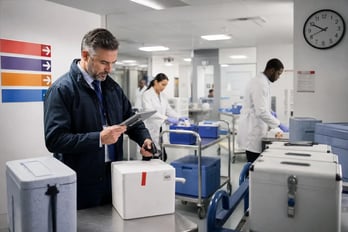
Laboratories measure everything.
-
Test accuracy.
-
Specimen volumes.
-
Processing times.
-
Quality indicators.
But when it comes to specimen transportation, many organizations focus on one number:
On-time performance.
It's an important metric.
But by itself, it doesn't tell the complete story.
One of the most valuable measurements in laboratory logistics isn't simply whether a courier arrived on time.
It's how long it took to complete the entire transportation process.
That's why turnaround time is one of the most meaningful performance indicators a laboratory can track.
What Is Turnaround Time?
In laboratory logistics, turnaround time measures the total time required to complete a delivery.
For a STAT specimen, that often means:
From the moment the pickup is requested…
…to the moment the specimen arrives at the laboratory.
Unlike a simple "on-time" measurement, turnaround time captures the entire transportation experience.
It answers the question:
"How quickly are specimens actually moving through our logistics network?"
Why On-Time Performance Doesn't Tell the Whole Story
Imagine two courier services.
Courier A promises a two-hour STAT delivery.
Courier B also promises a two-hour STAT delivery.
At the end of the month, both report a 98% on-time performance.
At first glance, they appear identical.
But then you look at the average turnaround time.
Courier A averages 68 minutes.
Courier B averages 112 minutes.
Both technically met the service commitment.
But one laboratory consistently receives specimens much sooner.
That's why turnaround time provides a much clearer picture of operational performance.
Why Faster Isn't Always the Goal
Turnaround time isn't simply about speed.
It's about consistency.
Laboratories need confidence that specimens will arrive within the expected timeframe so testing can begin as planned.
Consistent transportation helps support:
- Predictable laboratory workflows
- Better staffing utilization
- Reliable result reporting
- Improved provider expectations
- Better patient experiences
The goal isn't to rush every delivery.
The goal is to deliver reliably and consistently.
Different Specimens Have Different Expectations
Not every specimen requires the same response time.
For example:
STAT Specimens
STAT specimens often require immediate transportation.
Many laboratories define STAT expectations as:
- 60 minutes
- 90 minutes
- 2 hours
Clearly defining these expectations helps ensure everyone understands what "STAT" actually means.
Routine Specimens
Routine specimens typically follow scheduled pickup routes throughout the day.
Although urgency may be lower, consistency remains critical.
Late pickups can delay processing and affect next-day results.
The expected turnaround time should match the clinical need.
Turnaround Time Reveals Operational Problems
One of the greatest benefits of tracking turnaround time is that it helps identify issues before they become larger problems.
For example:
An increase in average turnaround time may indicate:
- Route inefficiencies
- Traffic challenges
- Staffing shortages
- Increased delivery demand
- Collection site delays
Without measuring turnaround time, these operational issues may remain hidden until service problems become more noticeable.
The Relationship Between Turnaround Time and Patient Care
Every specimen represents a patient.
The faster a specimen reaches the laboratory, the sooner testing can begin.
That can mean:
- Faster diagnoses
- Earlier treatment decisions
- Reduced patient anxiety
- Improved clinical workflows
Transportation may only represent one part of the testing process.
But it influences everything that follows.
Turnaround Time Should Be Paired With Other Metrics
While turnaround time is one of the most valuable logistics KPIs, it shouldn't be viewed in isolation.
Laboratories should also monitor:
- On-time pickup performance
- On-time delivery performance
- Pickup volume by location
- Route activity
- Chain-of-custody exceptions
- Specimen volume trends
Together, these metrics provide a complete picture of logistics performance.
What Happens When You Don't Measure It?
One laboratory manager was asked a few simple questions:
- What's your average turnaround time?
- What's your on-time delivery percentage?
- What's your cost per delivery?
She couldn't answer them.
Not because the laboratory lacked strong leadership.
But because no one had ever provided meaningful logistics performance data.
Once she realized that visibility was missing, the conversation changed.
Instead of assuming everything was working, she began asking better questions.
Where are delays occurring?
Which routes perform best?
Which locations generate the highest transportation volume?
Those answers created opportunities to improve operations.
The Better Question
Many laboratories ask:
"Did we make the pickup on time?"
A better question is:
"How long did it actually take to move the specimen from collection to the laboratory?"
That's the number that tells the real story.
Final Thought
On-time performance is an important benchmark.
But it only measures whether a commitment was met.
Turnaround time measures how efficiently your logistics operation actually performs.
For laboratories striving to improve specimen transportation, reduce delays, and gain greater operational visibility, few metrics provide more value.
Because what gets measured gets improved.
And when laboratories understand their turnaround times, they gain the insight needed to improve both logistics performance and patient care.
Frequently Asked Questions
What is turnaround time in laboratory logistics?
Turnaround time measures the total time from when a specimen pickup is requested until the specimen arrives at the laboratory for processing.
Why is turnaround time important?
Turnaround time provides visibility into transportation performance, helping laboratories identify delays, improve efficiency, and support timely diagnostic testing.
How is turnaround time different from on-time performance?
On-time performance measures whether deliveries met a predefined service commitment. Turnaround time measures the actual amount of time required to complete the transportation process.
What is considered a STAT specimen?
A STAT specimen requires immediate transportation and processing. Many laboratories define STAT service levels as 60-minute, 90-minute, or two-hour response times.
Should laboratories track both turnaround time and on-time performance?
Yes. Together, these metrics provide a more complete understanding of transportation performance than either metric alone.
What factors can increase turnaround time?
Common causes include traffic, route inefficiencies, staffing shortages, increased delivery demand, collection site delays, and operational bottlenecks.
What other logistics KPIs should laboratories monitor?
In addition to turnaround time, laboratories should monitor on-time pickups, on-time deliveries, pickup volumes, route activity, specimen counts, and chain-of-custody performance.
How can laboratories improve turnaround time?
Improving visibility into transportation operations, monitoring performance metrics, optimizing routes, and identifying recurring delays can help laboratories reduce turnaround times and improve logistics performance.