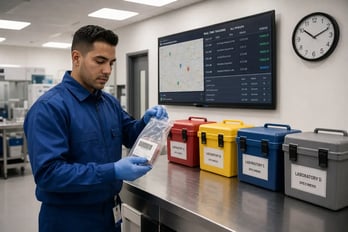
Every laboratory depends on one critical assumption:
The right specimen will arrive at the right laboratory at the right time.
Most of the time, that happens without issue.
But what happens when it doesn't?
It's easy to think of a delayed or missing specimen as a transportation problem.
In reality, the consequences extend much further.
A transportation failure can delay diagnoses, require patients to undergo additional procedures, disrupt laboratory workflows, and increase operational costs.
In healthcare, every specimen represents a patient waiting for answers.
That's why specimen transportation is much more than moving containers from one location to another.
It's an essential part of the diagnostic process.
Every Specimen Represents a Patient
Laboratory professionals rarely think of specimens as packages.
Each specimen tells a clinical story.
It may represent:
- A patient awaiting a cancer diagnosis.
- A child being tested for an infection.
- A surgical biopsy.
- A routine blood draw.
- A bone marrow sample.
The transportation process is responsible for protecting that specimen until testing can begin.
If transportation fails, everything that follows may be affected.
The Hidden Consequences of Transportation Failures
When a specimen doesn't arrive as expected, several things can happen.
Delayed Testing
The laboratory cannot begin testing until the specimen arrives.
Every hour of delay extends the overall diagnostic timeline.
That affects providers, laboratory staff, and ultimately the patient.
Workflow Disruptions
Laboratories schedule staffing and testing around expected specimen arrivals.
Unexpected delays can interrupt those workflows and create operational inefficiencies throughout the day.
Additional Administrative Work
When a specimen is delayed, staff often begin searching for answers.
Questions quickly arise:
- Was it picked up?
- Which courier has it?
- Was it delivered?
- Is it at the wrong laboratory?
- Does it need to be recovered?
Resolving those questions requires time and coordination.
When a Missed Pickup Becomes a Patient Problem
One of the most common transportation issues isn't a lost specimen.
It's a missed pickup.
Imagine this scenario.
A courier arrives at a physician's office for a scheduled specimen pickup.
The lockbox is empty.
Assuming there are no specimens to collect, the courier leaves.
A few minutes later, staff place the day's specimens into the lockbox.
The courier has already departed.
Those specimens remain overnight.
The next morning, some may no longer be viable for testing.
Now the laboratory must notify the provider.
The provider contacts the patient.
The patient must return for another collection.
A simple missed pickup has now affected multiple people and delayed care.
Some Specimens Cannot Be Replaced
Not every specimen can simply be collected again.
Some require extraordinary care because they are irreplaceable.
Biopsy Specimens
Biopsy specimens often involve human tissue collected to diagnose serious conditions such as cancer.
If a biopsy specimen is lost or compromised during transportation, the consequences may be significant because the tissue cannot simply be recreated.
Bone Marrow Samples
Bone marrow collection is an invasive and often painful procedure.
Transportation failures involving bone marrow specimens may require patients to undergo the procedure again—something everyone hopes to avoid.
These are reminders that logistics isn't simply about moving specimens.
It's about protecting patients.
Why Chain of Custody Matters
Transportation failures don't always happen on the road.
Sometimes they occur during pickup.
For example, many medical offices have multiple specimen lockboxes outside their facilities.
If the wrong lockbox is opened—or specimens intended for one laboratory are mistakenly delivered to another—the chain of custody has been broken.
Without clear documentation and accountability, recovering those specimens becomes much more difficult.
Strong chain-of-custody procedures help laboratories know:
- What was picked up.
- When it was picked up.
- Who handled it.
- Where it was delivered.
That visibility helps reduce uncertainty when questions arise.
Transportation Is Part of the Diagnostic Process
Many people think diagnostics begin when specimens arrive at the laboratory.
In reality, diagnostics begin much earlier.
Proper transportation helps preserve:
- Specimen integrity
- Temperature requirements
- Collection timelines
- Chain of custody
- Testing accuracy
The laboratory can only produce reliable results if specimens arrive in the proper condition.
Transportation plays a critical role in making that possible.
Prevention Starts With Visibility
Many transportation failures are preventable.
The key is visibility.
Organizations that monitor logistics performance can identify issues such as:
- Missed pickups
- Delayed routes
- Chain-of-custody exceptions
- Turnaround time trends
- Collection site challenges
Those insights help laboratories improve operations before small issues become larger problems.
The Better Question
Many organizations ask:
"Did the specimen arrive?"
A better question is:
"What happened throughout the specimen's journey?"
Understanding that journey provides valuable insight into transportation performance, operational risk, and opportunities for improvement.
Final Thought
Specimen transportation is one of the least visible parts of laboratory operations.
Yet it directly influences patient care, laboratory efficiency, and diagnostic reliability.
Most transportation failures don't begin with a dramatic event.
They begin with small operational breakdowns:
A missed pickup.
An incorrect lockbox.
A delayed route.
An undocumented handoff.
Individually, these issues may seem minor.
Collectively, they can delay diagnoses, increase costs, and impact patient outcomes.
That's why the strongest laboratory logistics programs don't simply focus on moving specimens.
They focus on protecting every specimen—and every patient it represents—from collection through delivery.
Frequently Asked Questions
What happens if a laboratory specimen is delayed?
Delayed specimens can postpone testing, disrupt laboratory workflows, delay clinical decisions, and in some cases affect specimen viability.
What is a specimen redraw?
A specimen redraw occurs when a patient must return to provide another sample because the original specimen was lost, compromised, or no longer suitable for testing.
Why are biopsy and bone marrow specimens considered high risk?
These specimens are difficult—or impossible—to replace without repeating invasive procedures. Transportation failures involving these samples can have significant clinical consequences.
What is chain of custody in laboratory logistics?
Chain of custody is the documented process of tracking a specimen from collection through delivery, ensuring accountability and helping prevent errors or misplaced specimens.
Why are missed specimen pickups a problem?
Missed pickups can leave specimens at collection sites longer than intended, potentially compromising their viability and requiring patients to return for another collection.
How can laboratories reduce transportation failures?
Improving visibility into pickups, monitoring turnaround times, strengthening chain-of-custody procedures, and tracking logistics performance can help reduce transportation-related issues.
Why is specimen transportation important to patient care?
Transportation is a critical part of the diagnostic process. Proper handling and timely delivery help ensure specimens arrive in the condition needed for accurate testing and timely clinical decisions.
What should laboratories monitor to improve logistics performance?
Key metrics include turnaround time, on-time pickups, on-time deliveries, chain-of-custody compliance, route performance, and specimen transportation trends.