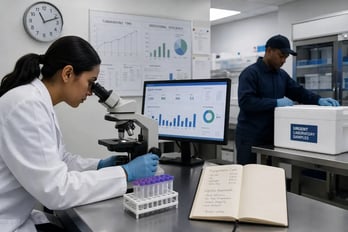
To someone outside the laboratory, every specimen pickup may look the same.
A courier arrives.
Specimens are collected.
They're transported to the laboratory.
Simple.
In reality, laboratory logistics is far more complex.
Not every specimen has the same urgency.
Not every delivery follows the same process.
And treating every specimen as though it has identical transportation requirements can create unnecessary costs, operational inefficiencies, and delayed patient care.
Understanding the difference between STAT and routine specimen transport is one of the most important aspects of laboratory logistics.
What Is a STAT Specimen?
A STAT specimen requires immediate transportation and processing.
The purpose is simple:
Get the specimen to the laboratory as quickly as possible so testing can begin without delay.
These deliveries often support situations where clinical decisions cannot wait.
Depending on the laboratory's requirements, STAT transportation may be defined as:
- 60-minute response
- 90-minute response
- Two-hour response
The important point is that "STAT" should have a clearly defined expectation.
Without a shared understanding of what STAT means, laboratories and courier providers may have very different expectations for response time.
What Is Routine Specimen Transport?
Routine specimens follow a different workflow.
Throughout the day, physician offices, clinics, and urgent care centers collect patient specimens.
Rather than requesting immediate transportation after each collection, these specimens are typically consolidated for a scheduled pickup.
At the end of the day, specimens are placed into designated collection containers or lockboxes where a courier retrieves them during a planned route.
Routine transportation prioritizes efficiency while still ensuring specimens arrive within the required timeframe for processing.
Why the Difference Matters
Although both involve specimen transportation, STAT and routine logistics require different operational strategies.
STAT Transportation Prioritizes Speed
STAT deliveries focus on minimizing transportation time.
Every minute matters.
Routes are adjusted to respond immediately.
Drivers may bypass scheduled work to complete urgent pickups.
Performance is often measured using:
- Response time
- Turnaround time
- On-time performance
The objective is rapid transportation.
Routine Transportation Prioritizes Efficiency
Routine routes are designed differently.
Instead of responding immediately to every collection, couriers optimize scheduled pickups across multiple locations.
Performance focuses on:
- Route efficiency
- Pickup consistency
- Collection timing
- Transportation reliability
The objective is completing many pickups efficiently while maintaining specimen integrity.
Different Workflows Require Different Metrics
Because STAT and routine transportation have different objectives, they should not be evaluated using identical performance measures.
Important STAT Metrics
- Average turnaround time
- Response time
- On-time performance
- Delivery exceptions
Important Routine Metrics
- Route efficiency
- Pickup completion rates
- Pickup timing consistency
- Specimen volume by location
Tracking the appropriate metrics helps laboratories better understand how each part of their transportation network is performing.
The Risk of Treating Every Specimen the Same
One of the most common mistakes in laboratory logistics is applying the same operational approach to every delivery.
Doing so can create several challenges.
Prioritizing every pickup as urgent reduces route efficiency.
Treating urgent specimens as routine delays testing.
Neither approach supports optimal laboratory performance.
The goal isn't simply transporting specimens.
It's matching the transportation strategy to the clinical need.
Routine Routes Still Require Attention
Routine transportation is sometimes viewed as less critical because specimens are not immediately needed.
However, routine pickups create their own risks.
For example, if a courier arrives for a scheduled pickup and finds an empty lockbox, leaving without confirming whether specimens are still being prepared can create significant downstream problems.
If specimens are placed in the lockbox after the courier departs, they may remain overnight.
That can lead to:
- Delayed testing
- Specimen degradation
- Patient redraws
- Additional operational costs
Even routine transportation requires careful communication and accountability.
Transportation Supports Patient Care
Whether a specimen is STAT or routine, transportation plays a direct role in patient care.
Reliable logistics helps laboratories:
- Protect specimen integrity
- Meet testing timelines
- Reduce delays
- Improve operational efficiency
- Support timely clinical decisions
Every transportation decision ultimately affects the patient's diagnostic journey.
The Better Question
Many organizations ask:
"Is this a STAT delivery or a routine pickup?"
A better question is:
"What transportation approach best supports this specimen and the patient behind it?"
That shift in thinking helps laboratories build transportation processes that align with both operational efficiency and clinical priorities.
Final Thought
STAT and routine specimen transportation serve different purposes.
One prioritizes immediate response.
The other emphasizes efficient, consistent collection.
Neither is more important than the other.
Both are essential to a successful laboratory logistics program.
The strongest laboratories understand these differences, establish clear expectations, and measure performance accordingly.
Because when transportation strategies match clinical needs, laboratories operate more efficiently—and patients receive answers sooner.
Frequently Asked Questions
What is a STAT specimen?
A STAT specimen requires immediate transportation and processing because clinical decisions depend on receiving test results quickly.
What is routine specimen transport?
Routine specimen transport involves scheduled pickups from healthcare facilities, allowing specimens collected throughout the day to be transported efficiently to the laboratory.
What turnaround times are common for STAT deliveries?
Many laboratories define STAT transportation using service commitments such as 60-minute, 90-minute, or two-hour response times, depending on clinical needs.
Why shouldn't STAT and routine specimens be handled the same way?
STAT specimens require rapid transportation to support urgent clinical decisions, while routine specimens are typically transported using optimized collection routes designed for efficiency.
What metrics should laboratories use for STAT transportation?
Common metrics include turnaround time, response time, on-time performance, and delivery exceptions.
What metrics are important for routine transportation?
Route efficiency, pickup completion rates, pickup consistency, and specimen volume by location are commonly used to evaluate routine logistics performance.
Can routine specimen transportation affect patient care?
Yes. Missed pickups, transportation delays, or communication breakdowns during routine routes can delay testing, compromise specimen integrity, and lead to patient redraws.
How can laboratories improve both STAT and routine transportation?
Clear service expectations, defined response times, meaningful logistics metrics, strong communication, and consistent transportation processes all contribute to better performance.